Showing posts with label Education. Show all posts

Sunday, February 26, 2012

Earn upto Rs 9000pm (Rs 100) will be credited just if You sign up

An  Easy way to earn Money online
 (Rs 100) will be credited Just if You sign up


So Just Click here and signup And get Rs 100 Instantly


Earn upto Rs. 9,000 pm checking Emails. Join now!
  1. This is a unique Way to earn Money online very easily that brings together the Advertisers and Members. 
  2. You need to login to your PaisaLive Account daily. For each unique login in 24 hours, we credit your account with a login incentive.
  3. PaisaLive also pays you when you refer your friends to join this website and be a part of this unique revolution.
Earn Upto RS 9000 Per/month

So Just Click here and signup And get Rs 100 Instantly


Earn upto Rs. 9,000 pm checking Emails. Join now!


Friday, February 10, 2012

Airtel New working Proxies Feb 2012 100% working

Hi, These are  the working Airtel proxies with good speed
Make settings in Mozilla or opera


100% Working proxy servers For airtel By www.mithhacks.blogspot.com


If you like My post , Like us on our Facebook Fanpage


Free Trick 1 : Mithhacks


Apn- airtelgprs.com 
ip- sneakme.net
port- 80
hp- http://fb.me/index.php

Free Trick 2 : Mithhacks


Apn: Airtelgprs.com
Proxy: 174.142.196.230
Port: 80
HomePage: fb.me (or) m.twitter.com


Free Trick  3 : Mithhacks


Apn: Airtelgprs.com
Proxy: German-proxy.de (or) 91.143.83.139
Port: 80


Free Trick 4 : Mithhacks


Apn:   Airtelgprs.com
Proxy: 74.63.88.156
Port:  80
HomePage: Fb.me (or) M.Twitter.com [recommended]


Free Trick 5 : Mithhacks


Apn: Airtelgprs.com
Proxy: 85.214.50.141
Port:  80
HomePage:  fb.me (or) m.twitter.com


For Vpn Trick 2012 Comment Below  And Like us


Thursday, October 20, 2011

Google Street Theater/Street View

Google Street Theater
Aussie penis pranksters deface Google Street View
by Asher Moses
The Sydney Morning Herald
September 9, 2011
Pranksters have been playing tricks on Google’s Street View cameras ever since the mapping tool was first launched in 2007, but miscreants in Victoria have delivered a low blow.
Street View images of Long Gully and Maiden Gully near Bendigo in Victoria have been defaced with a giant green penis outline after vandals climbed on top of one of Google’s camera-equipped cars and drew the phallus on its camera lens.

View Larger Map
The find was first discovered by users on BuzzFeed and has since gone viral across the web. Google Australia has yet to remove the images or make a comment on the matter – and it is not clear who is responsible.
It follows the June discovery of an array of six penises etched into the grass of a school in Waikato, New Zealand.

Street View has captured everything from marriage proposals to rock stars in bath tubs to canoodlng couples to topless sunbathers topeople passed out in the street. Mooning and flipping the bird at Google’s all-seeing eye is commonplace, while others have used Street View to create art.
In August last year a nine-year-old girl shocked the world after Street View cameras captured her lying on the pavement of a street in England. Tabloids raced to the story but it turned out she was unharmed.
“I didn’t know anything about the Google Street View car [recording me]. I fell over while I was playing with my friend and thought it would be funny to play dead,” she told the Daily Mail.
Late last year Google Maps was blamed for Nicaraguan troops invading Cosa Rica and it also sparked a dispute between Morocco and Spain. Street View’s launch in Brazil shocked the internet with images of dead bodies, gang arrests, prostitutes and kids doing drugs.
In December, Iran was furious after discovering on Google Maps that the roof of the Iran Air headquarters is adorned with a Star of David. In 2007, the US Navy’s headquarters had to be redesigned after aerial Google Maps shots revealed it was built in the shape of a Swastika.
Other top Google Maps discoveries include a clay formation in Canadathat looks like a person listening to an iPod, a corn field maze depicting Oprah Winfrey’s face and a series of shots showing the Street View car hitting a deer.
In 2009 Dutch police arrested twin brothers on suspicion of robbery after their alleged victim spotted a picture of them following him on Street View.
In October last year Google’s Street View cars were pulled from the streets of Australia after the search giant was investigated forslurping Australians’ private Wi-Fi network data. However, Google’s cars hit the road again in May this year and in July it updated its Street View imagery of Australia with new higher quality snaps.

Latest New Front Queries For Airtel

LATEST FRONT QUERIES FOR AIRTEL
FREE GPRS MO TRICKS 2011!

Phone Proxy Settings:Proxy IP:
zerolike.com or75.102.25.167Port:
80Front Query:
http://wap.mauj.com/cgiproxy/ [nofollow]
Phone Proxy Settings:Proxy IP:
venus.wsb-nlu.edu.pl
or195.205.100.200Port: 80Front
Query:
http://wap.mauj.com/mbar3/ [nofollow]net/nph-
proxy.cgi/010110A/
http/Phone Proxy Settings:Proxy
IP: uploader.ru or 217.65.12.26Port:
80Front Query:
http://wap.mauj.com/cgi-bin/ [nofollow]proxy/nph-proxy.cgi/0/
http/Phone Proxy Settings:Proxy
IP: obmem.com or70.40.213.103Port:
80Front Query:
http://wap.mauj.com/cgi-bin/
[nofollow]nph-proxy.cgi/010100A/ http/Phone Proxy Settings:Proxy
IP: uvirtual.dpicuto.edu.bo orFront
Query:
http://wap.mauj.com/cgi-bin/
[nofollow]nph-proxy.cgi/000000A/
http/Phone Proxy Settings:Proxy IP: torproxy.net
or188.40.82.50Port: 80Front Query:
http://wap.mauj.com/[nofollow]
You can use these front queries in
modded,handler versions of
1.opera mini 4.2, 2.opera mini 5.1,
3.nimbuzz,
4.migg33,
5.ucweb7.1 e.t.c2.

No balance restrictions3.Use your
default Mobile office or Airtel live settings to enjoy airtel free
browsing&downloading in airtel

Wednesday, October 19, 2011

Make Your Computer Into A Server in 10 Minutes


Make Your Computer Into A Server in 10 Minutes (free software)
This covers how to quickly set up your computer (running Windows) as a server. This will allow you to host your own website from your computer and will let you to make web pages with 'buttons' allowing you to control things in your home (robots, cameras, etc) from the internet (I'll cover that in future instructables).

We'll be using apache: very popular, free, open source server software.

While making your computer into a server will be very quick, you should read through the Apache http server software documentation to learn about how to set it up securely (so that people don't hack into your computer). I'll give this advice but read elsewhere for more:
1) best to install this server software on an old computer that you don't use for anything other than as a server.
2) best to create a seperate user account in windows with limited system access and install this software in that account.

If you want to do this on linux instead of windows (more secure, slightly more complicated) the best combination would be puppy linux and xamp for the server software. Puppy linux can be loaded off a usb jump drive or a CD, so you don't need to uninstall windows, just boot the computer with one of those. Here's easy setup videos for puppy linux: http://rhinoweb.us/
See this instructable for how to install xamp once you have puppy linux (or some other linux) working:
http://www.instructables.com/id/Make-a-Server-Out-Of-An-Old-PC/ 
 

Step 1Download Apache Server Software

Download Apache Server Software
Download the apache http server software from this apache mirror site:

http://www.reverse.net/pub/apache/httpd/binaries/win32/
_Or_ go to http://www.apache.org/, navigate to the download from mirrors page, pick a mirror and download from there. As you can see from the above link, you'll want to navigate to the mirror's apache, httpd, binaries, win32 folder.

What To Download:
= You should download the newest version (highest version number), it's 2.2.6 as I type this. Check here to see what the newest version is if you want: http://httpd.apache.org/
= You want the .msi file, this is a windows installation file (like an .exe)

Step 2Install It

Double click the .msi file you just downloaded, it will install, use the default settings, typical install (unless you want the source code, then do custom install).

It should automatically fill in some form boxes with your DNS server name (in my case it was earthlink.net) during the installation.
for server name, put whatever you want, I don't think spaces are allowed though. and make sure after your name you have .earthlink.net (or whatever DNS name is).
for email, put in your email (or don't doesn't matter much).

Step 3Run It

  • running.jpg
  • run.jpg
Once it's installed I think it starts the server running right away. You can see if it's running by looking for the icon in the lower right of your task bar (see pic). If it's not running and you want to start it, or stop it, just navigate in your start menu (see pic).

if you get an error message when you try to start the server write down the error# and look it up in the documentation or google.

Step 4Test It

Test it out, when you're sure the server is running open a web browser and type:
http://localhost
into the address bar, this should show up (see pic).

Yay, it works, now do something useful with it .

Friday, October 7, 2011

Get short And Instant Email address from our site


GET YOUR OWN EMAIL ADDRESS


Get short And Instant Email address from our site

* Indicates mandatory field


*UserName:

Must 6 chrctr

*Password:
*Confirm Password:

*Email:
Eg. Ur_name@in.com

*Mobile No:
Your's Mobile number. In case If you forgot  password This will help You..


 For checking Emails :


Sunday, October 2, 2011

Tracing an IP, getting...IP Address, nslookup, Reverse DNS, WHOIS, tracert, traceroute Ankit Fadia


Powered by www.mithhacks.blogspot.com


Tracing an IP, getting...IP Address, nslookup, Reverse DNS, WHOIS, tracert, traceroute Ankit Fadia


______________________________________________________________________________
Getting geographical Information using an IP Address By Ankit Fadia
______________________________________________________________________________
Getting the Internet Protocol or the IP Address of a remote system is said to the most important step in hacking of a
system. Sometimes, however we get an IP in order to get more information on someone or some host. But, how can
an IP Address be used to get more information on the location etc of a system? Well, this manual is aimed at
answering just this question.
Actually, the IP address (Actually the entire TCP/IP Protocol) is structured or designed such that one cannot tell as to
in which country a system having the given IP is situated, by simply looking at it. An IP Address has no fields, which
tell you the country in which the computer using it resides in. So, all myths like ‘The Second or the third field of an
IP stands for the country in which the system using it resides’ are definitely false and untrue.
However, yes sometimes one can guess or deduce as to in which country and even in which city the system using an
IP resides in, by simply looking at the first three fields of the IP. Let us take an example to understand what I mean to
say by this. Now, before I move on the example, let us understand how exactly IP Addresses are awarded to you.
Firstly, your ISP registers at the central authority and gets a particular range of IP addresses between which the
various customers (people who dial into their servers) can be awarded IP addresses. Most ISP’s are given a Class C
network Address. A class C Network address contains a 24-bit Network Prefix (the first three fields) and an 8-bit
Host number (the last field). It is referred to as "24's" and is commonly used by most ISP's.
******************


Like in the real world, everyone has got an individual Home Address or telephone number so that, that particular
individual can be contacted on that number or address, similarly all computers connected to the
Internet are given a unique Internet Protocol or IP address which can be used to contact that particular computer. In
geek language an IP address would be a decimal notation that divides the 32- bit Internet addresses (IP) into four 8-
bit fields.
Does the IP address give me some information or do the numbers stand for anything?
Let take the example of the following IP address: 202.144.49.110 Now the first part, the numbers before the first
decimal i.e. 209 is the Network number or the Network Prefix.. This means that it identifies the number of the
network in which the host is. The second part i.e. 144 is the Host Number that is it identifies the number of the host
within the Network. This means that in the same Network, the network number is same. In order to provide
flexibility in the size of the Network, here are different classes of IP addresses:
Address Class Dotted Decimal Notation Ranges
Class A ( /8 Prefixes) 1.xxx.xxx.xxx through 126.xxx.xxx.xxx
Class B ( /16 Prefixes) 128.0.xxx.xxx through 191.255.xxx.xxx
Class C ( /24 Prefixes) 192.0.0.xxx through 223.255.255.xxx


The various classes will be clearer after reading the next few lines.
Each Class A Network Address contains a 8 bit Network Prefix followed by a 24-bit host number. They are
considered to be primitive. They are referred to as "/8''s" or just "8's" as they have an 8-bit Network prefix.
In a Class B Network Address there is a 16 bit Network Prefix followed by a 16-bit Host number. It is referred to as
"16's".
A class C Network address contains a 24-bit Network Prefix and a 8 bit Host number. It is referred to as
"24's" and is commonly used by most ISP's.
Due to the growing size of the Internet the Network Administrators faced many problems. The Internet routing tables
were beginning to grow and now the administrators had to request another network number from the Internet before a
new network could be installed at their site. This is where sub-netting came in.
Now if your ISP is a big one and if it provides you with dynamic IP addresses then you will most probably see that
whenever you log on to the net, your IP address will have the same first 24 bits and only the last 8 bits will keep
changing. This is due to the fact that when sub-netting comes in then the IP Addresses structure becomes:
xxx.xxx.zzz.yyy
where the first 2 parts are Network Prefix numbers and the zzz is the Subnet number and the yyy is the host number.
So you are always connected to the same Subnet within the same Network. As a result the first 3 parts will remain
the same and only the last part i.e. yyy is variable.
***********************
For Example, if say an ISP xyz is given the IP: 203.98.12.xx Network address then you can be awarded any IP,
whose first three fields are 203.98.12. Get it?
So, basically this means that each ISP has a particular range in which to allocate all its subscribers. Or in other words,
all subscribers or all people connected to the internet using the same ISP, will have to be in this range. This in effect
would mean that all people using the same ISP are likely to have the same first three fields of their IP Addresses.
This means that if you have done a lot of (By this I really mean a lot) of research, then you could figure out which
ISP a person is using by simply looking at his IP. The ISP name could then be used to figure out the city and the
country of the person. Right? Let me take an example to stress as to how cumbersome but easy (once the research is
done) the above method can be.
In my country, say there are three main ISP’s:
ISP Name Network Address Allotted
ISP I 203.94.47.xx
ISP II 202.92.12.xx
ISP III 203.91.35.xx
Now, if I get to know the IP of an e-pal of mine, and it reads: 203.91.35.12, then I can pretty easily figure out that he
uses ISP III to connect to the internet. Right? You might say that any idiot would be able to do this. Well, yes and no.
You see, the above method of finding out the ISP of a person was successful only because we already had the ISP
and Network Address Allotted list with us. So, what my point is, that the above method can be successful only after a
lot of research and experimentation. And, I do think such research can be helpful sometimes.
Also, this would not work, if you take it all on in larger scale. What if the IP that you have belongs to someone living
in a remote igloo in the North Pole? You could not possibly get the Network Addresses of all the ISP’s in the world,
could you?


NOTE: In the above case, you also get to know the city of the system using the given IP, as most ISP’s use different
network addresses in different cities. Also, some ISP’s are operational in a single city.
So, is there a better method of getting the location of an IP? Yes, Reverse DNS lookups hold the key.
Just as DNS lookup converts the hostname into IP address, a Reverse DNS Lookup converts the IP address of a host
to the hostname. By hostname, what I mean to say is that it given us the name of the remote system in alphabets and
numbers and periods. For Example, mail2.bol.net.in would be a hostname, while 203.45.67.98 would not be a
hostname.
The popular and wonderful Unix utility ‘nslookup’ can be used for performing Reverse DNS lookups.
So, if you using a *nix box or if you have access to a shell account, then the first this to do is to locate where the
nslookup command is hidden by issuing the following command:
' whereis nslookup '.
Once you locate where the utility is hidden, you could easily use it to perform both normal and reverse DNS lookups.
As this is not a manual on using the ‘nslookup’ command, I will simply giving a basic relevant outline. In order to
get a more detailed description of how this works or how to use it, read the *nix man pages or the documentation.
We can use ‘nslookup’ to perform a reverse DNS lookup by mentioning the IP of the host at the prompt.
For Example,
$>nslookup IP Address
Note: The below IP’s and corresponding hostnames have been made up. They may not actually exist.
Let us say, that above, instead of IP Address, we type 203.94.12.01 (which would be the IP I want to trace.).
$>nslookup 203.94.12.01
Then, you would receive a response similar to: mithhacks.blogspot.com
Now, if you carefully look at the hostname that the Reverse DNS lookup, gave us, then the last part reveals the
country in which system resides in. You see, the ‘.in’ part signifies that the system is located in India. All countries
have been allotted country codes, which more often than not are the last part of the hostnames of the systems located
in that country. This method can also be used to figure out as to which country a person lives in, if you know his
email address. For Example, if a person has an email address ending in .ph then he probably lives in Philippines and
if it ends in .il then he lives in Israel and so on. Some common country codes are:
Country Code
Australia .au
Indonesia .id
India .in
Japan .jp
Israel .il
Britain .uk
For a complete list of country codes, visit:
http://www.alldomains.com/
http://www.iana.org/domain-names.html
*****************
General Extra Tip: To get the complete list of US State Abbreviation codes, visit:
http://www.usps.gov/ncsc/lookups/abbr_state.txt
****************
Windows users can perform Reverse DNS queries by downloading an utility called Samspade from: http://www.samspade.com/
Another method of getting the exact geographical location of a system on the globe is by making use of the WHOIS
database. The WHOIS database is basically the main database, which contains a variety of information like contact
details, name etc on the person who owns a particular domain name. So, basically what one does in a WHOIS query,
is supply the WHOIS service with the hostname on which he wants more information. The WHOIS service then
replies with the information stored in its database.
This method can be used to get some pretty accurate information on a particular IP or hostname; however, it is
probably of no use if you are trying to point out the exact location of a dynamic IP. But, again this can be used to get
atleast the city in which the ISP used by the victim is situated.
You can carry out WHOIS queries at: http://www.alldomains.com/
You could also directly enter the following in the location bar of your Browser and perform a WHOIS enquiry.
Enter the following in the location bar of your browser:
http://205.177.25.9/cgi-bin/whois?abc.com
Note: Replace abc.com with the domain name on which you want to perform a WHOIS query.
This method cannot be used to get the contact address of a person, if the IP that you use to trace him, belongs to his
ISP. So, either you need to know the domain name (which is registered on his name) or have to remain satisfied
knowing only the city (and ISP) used by the person.
Say, the victim has registered a domain name and you want to use it to find out the city in which he resides. Now,
one thing to remember in this case is that, if the victim has registered the domain name using any of the various free .
com registration services like Namezero.com etc, then the domain name would probably be registered on the company’s name and not the victim’s name. So, a WHOIS query will give information on the ISP and not the victim.
*****************
NEWBIE NOTE: The WHOIS service by default runs on Port 43 of a system. Try performing a WHOIS query by
telnetting to Port 43 and manually typing out the query. I have never tried it, however, it might be fun.
***************
Yet another and probably the second most efficient method (after Reverse DNS queries) of tracing an IP to its exact
geographical location, is to carry out a ‘traceroute’ on it. The ‘tracert’ or ‘traceroute’ commands give you the names
or IP’s of the routers through which it passes, before reaching the destination. Windows users can perform a trace of
an IP, by typing the following at the command line prompt:
C:\windows>tracert IP or Hostname
For more information about the usage and syntax of this command, type: ‘tracert’ at the command prompt.
Anyway, now let us see what is the result, when I do a tracert on my IP. Remember I live in New Delhi which is a
city in India. Watch the names of the hostnames closely, as you will find that they reveal the cities through which the
packet passes.

C:\windows>tracert 203.94.12.54
Tracing route to 203.94.12.54 over a maximum of 30 hops
1 abc.netzero.com (232.61.41.251) 2 ms 1 ms 1 ms
2 xyz.Netzero.com (232.61.41.0) 5 ms 5 ms 5 ms
3 232.61.41.10 (232.61.41.251) 9 ms 11 ms 13 ms
4 we21.spectranet.com (196.01.83.12) 535 ms 549 ms 513 ms
5 isp.net.ny (196.23.0.0) 562 ms 596 ms 600 ms
6 196.23.0.25 (196.23.0.25) 1195 ms1204 ms
7 backbone.isp.ny (198.87.12.11) 1208 ms1216 ms1233 ms
8 asianet.com (202.12.32.10) 1210 ms1239 ms1211 ms
9 south.asinet.com (202.10.10.10) 1069 ms1087 ms1122 ms
10 backbone.vsnl.net.in (203.98.46.01) 1064 ms1109 ms1061 ms
11 newdelhi-01.backbone.vsnl.net.in (203.102.46.01) 1185 ms1146 ms1203 ms
12 newdelhi-00.backbone.vsnl.net.in (203.102.46.02) ms1159 ms1073 ms
13 mtnl.net.in (203.194.56.00) 1052 ms 642 ms 658 ms
So, the above shows us that the route taken by a data to reach the supplied IP is somewhat like this:
Netzero (ISP from which the data is sent) ---à Spectranet (A Backbone Provider) -----à New York ISP ---àNew
York Backbone -à Asia --à South Asia -à India Backbone --à New Delhi Backbone --à Another router in New
Delhi Backbone ---à New Delhi ISP.
So, basically this tracert does reveal my real location, which is: New Delhi, India, South Asia. Get it?
Sometimes, doing a ‘tracert’ on an IP, does not give useful information. You see in the above example, the
hostnames returned revealed the city or country in which the system is located. Although, more often than not, you
http://www.alldomains.com/

Saturday, October 1, 2011

TCP/IP Protocol Suite and IP Addressing

n

TCP/IP Protocol Suite 

The U.S. DoD created the TCP/IP reference model because it wanted a network that could survive any conditions.TCP/IP model has become the Internet standard.
n
Application Layer

Handles high-level protocols, issues of representation, encoding, and dialog control
IP as a Routed Protocol

n

IP is a connectionless, unreliable, best-effort delivery protocol.


n


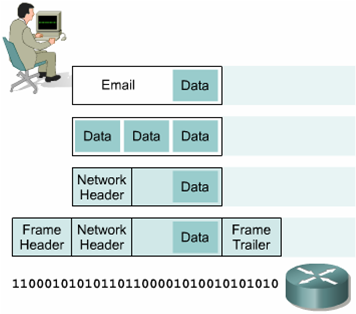
As information flows down the layers of the OSI model; the data is processed at each layer.

n


IP accepts whatever data is passed down to it from the upper layers.
Packet Propagation and Switching Within a Router
IP Address

n
An IP address is a 32-bit sequence of 1s and 0s. 


n
To make the IP address easier to use, the address is usually written as four decimal numbers separated by periods.  


n
This way of writing the address is called the dotted decimal format.  


Every IP address has two parts:  
1.
  • Network 
  • Host 
2.
IP addresses are divided into classes A,B and C to define large, medium, and small networks.

The Class D address class was created to enable multicasting.
IETF reserves Class E addresses for its own research.
Reserved IP Addresses
n
Certain host addresses are reserved and cannot be assigned to devices on a network.
n
An IP address that has binary 0s in all host bit positions is reserved for the network address.
n
An IP address that has binary 1s in all host bit positions is reserved for the broadcast address.
Subnet Mask Address
nDetermines which part of an IP address is the network field and which part is the host field.
nFollow these steps to determine the subnet mask:
u1. Express the subnetwork IP address in binary form.
u2. Replace the network and subnet portion of the address with all 1s.
u3. Replace the host portion of the address with all 0s.
u4. Convert the binary expression back to dotted-decimal notation.
Subnetting example

IP Private Addresses
n
No two machines that connect to a public network can have the same IP address because public IP addresses are global and standardized
n
Private IP addresses are a solution to the problem of the exhaustion of public IP addresses. Addresses that fall within these ranges
are not routed on the Internet backbone: 


Connecting a network using private addresses to the Internet requires the usage of NAT